Saturday, January 14, 2023

Artificial Intelligence (AI) Stages and Progress

 Artificial intelligence is a growing field of study, and it's essential to understand the possibilities and limitations of this technology. While there are many who believe that AI will soon replace human workers, there are others who think that AI has yet to even reach its full potential.

AI can help us automate tasks that would otherwise be done by humans, and it can also improve our lives in ways we never imagined possible before. The future of AI looks bright, and we can't wait to see what comes next!

Artificial Intelligence is on the rise. It's predicted to grow by 33% by 2023 and will only continue to expand as more companies discover its potential.

AI can be used to make work easier and more efficient, saving time and money for businesses. It can also help with data analysis, which allows you to understand your customers better and make better decisions about how you run your business. AI is going to be prevalent in the near future.

  • Reactive Machines
  • Limited Memory
  • Theory of Mind
  • Self-aware

AI has different levels, and each level of intelligence depicts a different stage in the development of AI. The three stages define the progress of Artificial Intelligence.

  1. The first stage is Artificial Narrow Intelligence (ANI). This refers to AI that can only perform one task at a time.
  2. The second stage is Artificial General Intelligence(AGI). This refers to AI that can perform multiple tasks with equal proficiency.
  3. The third stage is Artificial Super Intelligence(ASI). This refers to AI that has surpassed human intelligence in all areas.

Artificial Narrow Intelligence refers to any machine capable of performing a single task. This includes things like Siri, which is capable only of performing vocal commands and internet searches. It is considered narrow because it doesn't possess intelligence in the same way humans do. ANI systems can't think abstractly, form their own opinions or generalize skills across different tasks.

Artificial General Intelligence refers to any machine able to perform any human-like task, indistinguishable from human performance. Thus far, most of these systems have not yet been created or tested in the wild.

Artificial Super Intelligence refers to any machine that can outperform humans in virtually every single way possible. Again, this is theoretical, as the skill sets required for superintelligence don't necessarily exist on Earth today. For example, take education research. They simply don't have enough information to accurately predict every scenario and solve it right now. And until they do, AI will not be able to fully replace teachers as educators.

I will come up with more interesting topics on Machine Learning in the next blog. Until then have Good Fortune.


Thursday, December 1, 2022

EMD pingOMS error: unable to connect to http server

 When you are working on OEM agent upgrade. Sometimes you might face an error EMD pingOMS error: unable to connect to http server at OMShost. [handshake has no peer].

It is a sort of bug, with no proper fix. You can try various workarounds related to OEM agents, but most of them will not be helpful.

Error:

oracle@sajidserver01.com:$ ./emctl status agent
Oracle Enterprise Manager Cloud Control 13c Release 4
Copyright (c) 1996, 2018 Oracle Corporation.  All rights reserved.
---------------------------------------------------------------
Agent Version      : 13.4.0.0.0
OMS Version        :
(unknown)
Protocol Version   : 12.1.0.1.0
Agent Home         : /u05/app/oracle/agent13c/agent_inst
Agent Log Directory: /u05/app/oracle/agent13c/agent_inst/sysman/log
Agent Binaries     : /u05/app/oracle/agent13c/agent_13.4.0.0.0
Core JAR Location  : /u05/app/oracle/agent13c/agent_13.4.0.0.0/jlib
Agent Process ID       : 1769
Parent Process ID      : 1668
Agent URL              : <Link>
Local Agent URL in NAT : <Link>
Repository URL              :  <Link>
Started at                  : 2022-11-22 10:04:29
Started by user             : oracle
Operating System            : AIX version 7.1 (ppc64)
Number of Targets           : 16
Last Reload                 : (none)
Last successful upload           : 2022-11-22 16:28:12
Last attempted upload            : 2022-11-22 16:28:12
Total Megabytes of XML files uploaded so far   :18.21
Number of XML files pending upload             : 0
Size of XML files pending upload(MB)           : 0.01
Available disk space on upload filesystem      : 52.07%
Collection Status                            : Collections enabled
Heartbeat Status                             :
OMS is unreachable
Last attempted heartbeat to OMS              : 2022-11-22 16:28:29
Last successful heartbeat to OMS             : (none)
Next scheduled heartbeat to OMS              : 2022-11-22 16:28:29
---------------------------------------------------------------
Agent is Running and Ready

oracle@sajidserver01.com:$  ./emctl pingOMS
Oracle Enterprise Manager Cloud Control 13c Release 4
Copyright (c) 1996, 2018 Oracle Corporation.  All rights reserved.
---------------------------------------------------------------
EMD pingOMS error: unable to connect to http server at OMShost. [handshake has no peer]

oracle@sajidserver01.com:$  ./emctl upload agent
Oracle Enterprise Manager Cloud Control 13c Release 4
Copyright (c) 1996, 2018 Oracle Corporation.  All rights reserved.
---------------------------------------------------------------
EMD upload error:full upload has failed: uploadXMLFiles skipped :: OMS version not checked yet. If this issue persists check trace files for ping to OMS related errors. (OMS_DOWN)

Solution:

Drop the OEM targets related to this server from OEM. Decommission the agent as well. After that try installing the new agent. The beauty of this is you do not need to reconfigure the targets again, all the targets will be configured automatically. It will be an OEM self-healing process as part of automation.

Sunday, November 6, 2022

Oracle Server Database components status as Upgraded rather than Valid after Upgrade

A few times the database components will be in upgraded mode in the PDB once you have completed your database upgrade from 12c to version 19c.

column comp_name format a30
column status format a10
select comp_name, version, status from dba_registry;
COMP_NAME                              VERSION              STATUS
--------------------------------   ------------------      ----------
Oracle Database Catalog Views          19.0.0.0.0           UPGRADED
Oracle Database Packages and Types     19.0.0.0.0           UPGRADED
JServer JAVA Virtual Machine           19.0.0.0.0           UPGRADED
Oracle XDK                             19.0.0.0.0           UPGRADED
Oracle Database Java Packages          19.0.0.0.0           UPGRADED

SYS@sajiddb1>alter session set "_oracle_script"=TRUE;
session altered

SYS@sajiddb1>alter pluggable database pdb$seed close immediate instances=all;
Pluggable database altered.

SYS@sajiddb1>alter pluggable database pdb$seed OPEN READ WRITE force;
Pluggable database altered.

SYS@sajiddb1>alter session set container=PDB$SEED;
session altered

To resolve it follow the below steps.

@ORACLE_HOME/rdbms/admin/catalog.sql
@ORACLE_HOME/rdbms/admin/catproc.sql
@ORACLE_HOME/rdbms/admin/utlrp.sql

Check the components, it will be normal now.

SYS@sajiddb1>alter pluggable database pdb$seed close immediate instances=all;
Pluggable database altered.

SYS@sajiddb1>alter pluggable database pdb$seed OPEN READ ONLY force;
Pluggable database altered.

SYS@sajiddb1>show pdbs;
CON_ID  CON_NAME     OPEN MODE   RESTRICTED
------ ------------ ----------- ------------
 2       PDB$SEED     READ ONLY    NO

SYS@sajiddb1>alter session set "_oracle_script"=FALSE;
session altered


column comp_name format a30
column status format a10
select comp_name, version, status from dba_registry;
COMP_NAME                              VERSION               STATUS
--------------------------------    ----------------      ----------
Oracle Database Catalog Views          19.0.0.0.0             VALID
Oracle Database Packages and Types     19.0.0.0.0             VALID
JServer JAVA Virtual Machine           19.0.0.0.0             VALID
Oracle XDK                             19.0.0.0.0             VALID
Oracle Database Java Packages          19.0.0.0.0             VALID

Friday, September 2, 2022

ORA-01586: database must be mounted EXCLUSIVE and not open for this operation

 You can choose among multiple options to drop Oracle databases. 

1. DBCA (Silent Method or GUI)

2. Command Line Interface (startup mount restrict and then issue drop database) using sqlplus or rman
3. Manually cleaning up files

SQL> drop database;
drop database
*
ERROR at line 1:
ORA-01586: database must be mounted EXCLUSIVE and not open for this operation

We are decommissioning the RAC database here. So we need to change the parameter cluster_database=FALSE.

Set your database profile.

srvctl stop database -d <DB_name>
SQL> startup mount;
SQL> alter system enable restricted session;
SQL> alter system set cluster_database=FALSE scope=spfile;
SQL>Drop Database;
Database dropped.

How to find temporary MySQL Root Password after installation

 Sometimes once MySQL installation is done. You will not be able to find the temporary password, here I was working on the latest MySQL version 8.0.30-commercial MySQL Enterprise Server.

[root@Sajidserver01 ~]# grep -i pass /var/log/mysqld.log

Remove the /var/lib/mysql and restart mysqld as below

[root@Sajidserver01 ~]#cd /var/lib
[root@Sajidserver01 ~]#rm -rf mysql 
[root@Sajidserver01 ~]#systemctl stop mysqld
[root@Sajidserver01 ~]#systemctl start mysqld

Once it is done, you will find the new temporary password generated in mysqld.log below.

[root@Sajidserver01 ~]# grep -i pass /var/log/mysqld.log 
2022-09-01T21:32:34.029030Z 6 [Note] [MY-0454] [Server] A temporary password is generated for root@localhost: S2<3!chrde

Once it is done you can reset your password as per your standards using /usr/bin/mysql_secure_installation.


Monday, August 1, 2022

ORA-16525: The Oracle Data Guard broker is not yet available in the dataguard environment

 Sometimes you might be facing an error ORA-16525: The Oracle Data Guard broker is not yet available in the dataguard environment. It might occur because of multiple reasons, but one of the main reasons, is if the particular server is having the issue on which real-time apply is being applied gets rebooted. Then the real-time apply might be running on a different node and goes in hung mode. You can follow the below steps to remediate it.

[oracle@sajidserver01 ~]$ dgmgrl

DGMGRL for Linux: Release 19.0.0.0.0 - Production on Thu Jul 21 12:07:36 2022
Version 19.15.0.0.0
Copyright (c) 1982, 2019, Oracle and/or its affiliates.  All rights reserved.
Welcome to DGMGRL, type "help" for information.
DGMGRL> connect sys/<password>;
Connected as SYSDG.
DGMGRL> show configuration;
ORA-16525: The Oracle Data Guard broker is not yet available.
Configuration details cannot be determined by DGMGRL

###
Fix:
###

Bounce the standby database and enable the configuration in dgmgrl.

[oracle@sajidserver01 ~]$ srvctl stop database -d sajid_texas
[oracle@sajidserver01 ~]$ srvctl start database -d sajid_texas

[oracle@sajidserver01 ~]$ dgmgrl

DGMGRL for Linux: Release 19.0.0.0.0 - Production on Thu Jul 21 12:07:36 2022
Version 19.15.0.0.0
Copyright (c) 1982, 2019, Oracle and/or its affiliates.  All rights reserved.
Welcome to DGMGRL, type "help" for information.
DGMGRL> connect sys/<password>;
Connected as SYSDG.

DGMGRL> enable configuration;
Enabled.

DGMGRL> show configuration;
Configuration - SAJID_CONF
  Protection Mode: MaxPerformance
  Members:
  sajid_pittsburgh     - Primary database
  sajid_texas - Physical standby database
Fast-Start Failover: DISABLED
Configuration Status:
SUCCESS   (status updated 27 seconds ago)

You will see the alert log will be updated with an attempt to start the background Managed Standby Recovery process. MRP0: Background Managed Standby Recovery process started and the Managed Standby Recovery started Real-Time Apply.


Tuesday, July 12, 2022

ORA-29548:Java system reported: release mismatch

 When you are running the Preupgrade task to upgrade the database from 12c to 19.14.0.0.0 version either using DBUA or the Auto upgrade feature. Sometimes you might face the below error depending on your system. If you happen to run into below error, you can follow the below steps. One of the reasons you may find a similar issue is if an OJVM patch is applied or rolled back.

Error:

Contact Oracle Support for instructions on how to resolve this error. 

Error: ORA-29548 ORA-29548:Java system reported: release mismatch, 

12.2.0.1.180717 1.8 in database (classes.bin) vs 12.2.0.1.0 1.8 in executable

SQL> select dbms_java.lonname('TEST') from dual;

select dbms_java.lonname('TEST') from dual

                        *

ORA-29548: Java system class reported: joxcsys: release mismatch, 

12.2.0.1.180717 1.8 in database (classes.bin) vs 12.2.0.1.0 1.8 in executable

SQL> conn /as sysdba

Connected.

SQL>  @?/javavm/install/update_javavm_db.sql

SQL> SET FEEDBACK 1

SQL> SET NUMWIDTH 10

SQL> SET LINESIZE 80

SQL> SET TRIMSPOOL ON

SQL> SET TAB OFF

SQL> SET PAGESIZE 100

SQL> alter session set "_ORACLE_SCRIPT"=true;

Session altered.


SQL> -- If Java is installed, do CJS.

SQL> -- If CJS can deal with the SROs inconsistent with the new JDK,

SQL> -- the drop_sros() call here can be removed.

SQL> call initjvmaux.drop_sros();

Call completed.

SQL> create or replace java system;

Java created.

SQL> update dependency$

  set p_timestamp=(select stime from obj$ where obj#=p_obj#)

  where (select stime from obj$ where obj#=p_obj#)!=p_timestamp and

  (select type# from obj$ where obj#=p_obj#)=29  and

  (select owner# from obj$ where obj#=p_obj#)=0;

161 rows updated.

SQL> commit;

SQL> alter session set "_ORACLE_SCRIPT"=false;

Session altered.

SQL> select dbms_java.longname('TEST') from dual;

DBMS_JAVA.LONGNAME('TEST')

-------------------------------------------------------------

TEST

1 row selected.


Once the above steps are followed and recompile the invalid objects. Now if you run Preupgrade script, the above error will not pop up. 

Happy Oracle Database Upgrades!!!


Tuesday, November 16, 2021

Remove Oracle Multimedia in 19c

 Few of the Oracle documentation says Oracle Multimedia is deprecated in 19c. You might see the component name Oracle Multimedia (ORDIM) in the dba_registry once you login into the database, it might not function anymore. But still, to clean it up from the database end, you can implement the below steps.

[oracle@sajidserver01 ~]$ sqlplus "/ as sysdba"

SQL> alter session set "_oracle_script"=TRUE;

Session altered.

SQL> drop user MDSYS cascade;

User dropped.

SQL> @?/rdbms/admin/catcmprm.sql ORDIM

Session altered.

About to remove Oracle Multimedia.

Checking to see if anyone is using Oracle Multimedia.

Session altered.

Oracle Multimedia is not being used

PL/SQL procedure successfully completed.

Session altered.

Are you sure you want to remove Oracle Multimedia (Y/N): Y

PL/SQL procedure successfully completed.

Session altered.

Removing Oracle Multimedia

PL/SQL procedure successfully completed.

PL/SQL procedure successfully completed.

PL/SQL procedure successfully completed.

Commit complete.

PL/SQL procedure successfully completed.

PL/SQL procedure successfully completed.

Session altered.

Session altered.

SQL> alter session set "_oracle_script"=FALSE;

Session altered.

Now check your dba_registry it will be clean.

SQL> SELECT comp_id,comp_name,version FROM dba_registry where comp_id='ORDIM';

no rows selected

Make sure the above steps are implemented in all the pluggable databases as well. If not the databases will end up in restricted mode and users will not be able to connect.

######
Note:
######

If you face the below error while dropping the component name.

ERROR at line 1:
ORA-28014: cannot drop administrative users

To bypass it try using alter session set "_oracle_script"=TRUE; then you will be good to drop the component.

Friday, September 24, 2021

[INS-41210] one of the available network subnets is marked for use by ASM.

 When you opt for Advanced Installation for 12.1.0.2 Grid installation on RHEL 8 operating system and when you do designate the private interfaces subnets either as "ASM" or as "ASM & Private". You will get [INS-41210] one of the available network subnets is marked for use by ASM.


Solution:

Just use "Private" rather than "ASM & Private" for both the private interface subnets and leave the last one as Public for the Public interface subnet.

Friday, August 6, 2021

runcluvfy.sh command gets hung on 19c before Grid Installation

 When you are running pre-check for cluster installation using runcluvfy command in 19c to install on RHEL 8 operating system, it gets hung and does not generate any report.

[grid@sajidserver01 19000]$ ./runcluvfy.sh stage -pre crsinst -n sajidserver01,sajidserver02 -verbose==>hangs

To get the detailed output, you can follow the below workaround. By setting an environment variable.

[grid@sajidserver01 19000]$ export CV_ASSUME_DISTID=OL7
[grid@sajidserver01 19000]$ ./runcluvfy.sh stage -pre crsinst -n sajidserver01,sajidserver02 -verbose

     | |  | |  | |
     | |  | |  | |
     | |  | |  | |   Output is Truncated
   \                /
     \            /
       \        /
         \    /
           \/

CVU operation performed:  stage -pre crsinst
Date:  Aug 6, 2021 11:55:22 PM
CVU home:/usr/app/grid/product/19000/
User: grid

Hope this helps with Grid 19c RAC builds.


Friday, June 18, 2021

How to detach and attach Oracle Home to an inventory

Sometimes when you are working on database patching, you will notice opatch lsinventory will be completely corrupted. In the next few minutes, I will walk you through a step-by-step process of getting it fixed.

#####
Error:
#####
List of Homes on this system:
  Home name= OraGI12c_Home1, Location= "/usr/12.2/grid"
  Home name= agent13c2, Location= "/usr/agent13c/agent_13.2.0.0.0"
  Home name= OraDB12_Home1, Location= "/usr/product/12.2.0.2"
OPatchSession cannot load inventory for the given Oracle Home /usr/agent13c/agent_13.2.0.0.0. Possible causes are:
   No read or write permission to ORACLE_HOME/.patch_storage
   Central Inventory is locked by another OUI instance
   No read permission to Central Inventory
   The lock file exists in ORACLE_HOME/.patch_storage
   The Oracle Home does not exist in Central Inventory
   OUI-67073:UtilSession failed: RawInventory gets null OracleHomeInfo
UtilSession failed: RawInventory gets null OracleHomeInfo
Log file location: /usr/agent13c/agent_13.2.0.0.0/cfgtoollogs/opatch/opatch2021-01-02_01-30-00PM_1.log

####
Fix:
####

Detach and attach the home to fix it like below. Then check opatch lsinventory to make sure it is properly fixed. This system is a two-node Oracle RAC. One beauty is, this does not require any database downtime and can be fixed on the fly.

cd /usr/agent13c/agent_13.4.0.0.0/oui/bin
[oracle@sajidserver01 bin]$ ./detachHome.sh ORACLE_HOME=/usr/agent13c/agent_13.2.0.0.0 ORACLE_HOME_NAME=agent13c2 CLUSTER_NODES=sajidserver01, sajidserver02 INVENTORY_LOCATION=/usr/oraInventory LOCAL_NODE=sajidserver01
Launcher log file is /tmp/OraInstall2021/launcher2021-01-02_01-58-40PM.log.
Ignoring command-line variable "INVENTORY_LOCATION=/usr/oraInventory".
Checking swap space: must be greater than 500 MB.   Actual 34811 MB    Passed
Checking if this platform requires a 64-bit JVM.   Actual 64    Passed (64-bit not required)
detachHome was successful.
Logs successfully copied to /usr/oraInventory/logs.
cd /usr/agent13c/agent_13.2.0.0.0/oui/bin

Now attach the home.

[oracle@sajidserver01 bin]$ ./attachHome.sh ORACLE_HOME=/usr/agent13c/agent_13.2.0.0.0 ORACLE_HOME_NAME=agent13c2 CLUSTER_NODES=sajidserver01, sajidserver02 INVENTORY_LOCATION=/usr/oraInventory LOCAL_NODE=sajidserver01
Launcher log file is /tmp/OraInstall2021-02-17_02-59-22PM/launcher2021-02-17_02-59-22PM.log.
Checking swap space: must be greater than 500 MB.   Actual 34811 MB    Passed
Checking if this platform requires a 64-bit JVM.   Actual 64    Passed (64-bit not required)
attachHome was successful.
Logs successfully copied to /usr/oraInventory/logs.

Check the inventory, it will be fixed.

[oracle@sajidserver01 bin]$ opatch lsinventory
Oracle Interim Patch Installer version 13.9.4.2.2
Copyright (c) 2021, Oracle Corporation.  All rights reserved.
Oracle Home       : /usr/agent13c/agent_13.2.0.0.0
Central Inventory : /usr/oraInventory
   from                  : /usr/agent13c/agent_13.2.0.0.0/oraInst.loc
OPatch version    : 13.9.4.2.2
OUI version       : 13.9.4.0.0
Log file location : /usr/agent13c/agent_13.2.0.0.0/cfgtoollogs/opatch/opatch2021-01-02_07-00-50PM_1.log
   | |  | |  | |
     | |  | |  | |
     | |  | |  | |   Output is Truncated
  \                /
    \            /
      \        /
        \    /
          \/
OPatch succeeded.

Now your inventory is back in business.

Tuesday, May 11, 2021

Oracle RAC instance start and stop

Oracle RAC instance start and stop

[oracle@sajidserver1~]$srvctl status database -d sajiddb
Instance sajiddb2 is running on node sajidserver2
Instance sajiddb1 is running on node sajidserver1

[oracle@sajidserver1]srvctl stop instance –d sajiddb –i sajiddb1 -f
PRKO-3122 : -instance option or -node option is required for stopping an instance of database null

There is nothing wrong with the above command, but it suddenly stopped working. Anyhow, if you notice the error (PRKO-3122 : -instance option or -node option is required for stopping an instance of database null). To make it work, use the below command.

[oracle@sajidserver1]srvctl stop instance –db sajiddb –instance sajiddb1 -f
[oracle@sajidserver1]

The above command works for various oracle database versions 19c/18c/12c. Similarly to start the instance you can use the below command.

[oracle@sajidserver1]srvctl start instance –db sajiddb –instance sajiddb1
[oracle@sajidserver1]

Monday, February 15, 2021

Installing Oracle Enterprise Manager Cloud Control 13c Release 4 (13.4.0.0) on Oracle Linux 7


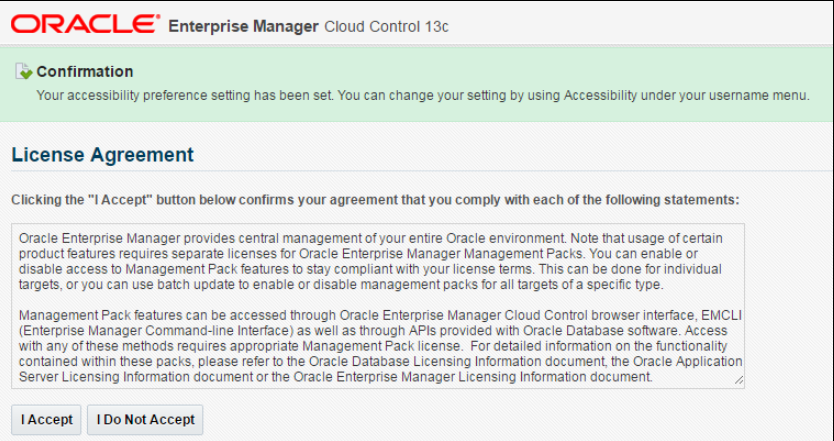
        In this post, I will be discussing installing Oracle Enterprise Manager Cloud Control 13c Release 4 (13.4.0.0) on Oracle Enterprise Linux 7. OEM makes the life of DBA or DMA much easier. You need to have the appropriate Linux OS packages, kernel parameters, and database parameters to be in place.  First, you need to install the repository database, for step by step instructions to install 12.2 database you can follow (Link)


[oracle@sajidserver ~]$ cd /usr/app/stage/

[oracle@sajidserver stage]$ ls -ltr

-rwxrwxr-x 1 oracle oinstall 1623577684 Jul 20 14:38 em13400_linux64.bin

-rwxrwxr-x 1 oracle oinstall 2109004737 Jul 20 14:48 em13400_linux64-2.zip

-rwxrwxr-x 1 oracle oinstall 2047749474 Jul 20 14:55 em13400_linux64-3.zip

-rwxrwxr-x 1 oracle oinstall 2117312528 Jul 20 15:05 em13400_linux64-4.zip

-rwxrwxr-x 1 oracle oinstall  808014516 Jul 20 15:09 em13400_linux64-5.zip

-rwxrwxr-x 1 oracle oinstall 2143125187 Jul 20 15:27 em13400_linux64-6.zip

-rwxrwxr-x 1 oracle oinstall 1879163226 Jul 20 15:34 em13400_linux64-7.zip

[oracle@sajidserver stage]$ ./em13400_linux64.bin

Launcher log file is /tmp/OraInstall2020_15AM/launcher2020_AM.log.

Extracting the installer . . . . . . . . . . . . . . . . . . . . . . . . . . . . . . . . . . . . . . . . . . . . . . . . . . . . . . . . . . . . . . . . . . . .  . . . . . . . . . . . . . . . . . . . . . . . . . . . . . . . . . . . . . . . . . . . . . . . . . . . . . . . . . Done

Checking monitor: must be configured to display at least 256 colors.  Actual unknown.  

Checking swap space: must be greater than 512 MB.   Actual 2047 MB    Passed

Checking if this platform requires a 64-bit JVM.   Actual 64    Passed (64-bit not required)

You must fulfill these requirements before continuing.

Continue? (yes [y] / no [n]) [n]

y

You have confirmed that the product can be installed on this platform.

Continuing with the installation.


At this point, you are done with the installation of  Oracle Enterprise Manager Cloud Control 13c Release 4 (13.4.0.0) on Oracle Linux 7. Please email me if anyone needs any advice during the installation, will be happy to help. Happy Monitoring!.


Saturday, December 26, 2020

ORA-00922: missing or invalid option

 Generally, when you are trying to create a user or trying to change the password with special characters or numbers, you will get the below error.

SQL>alter user test identified by 3esafe;

alter user test identified by 3esafe *

ERROR at line 1:

ORA-00922: missing or invalid option

SQL>create user test identified by am@zing;

create user test identified by am@zing *

ERROR at line 1:

ORA-00922: missing or invalid option


To fix it you need to use double quotes for setting the passwords, as below.


SQL>create user test identified by "am@zing";

User created.

SQL>alter user test identified by "3esafe";

User created.


Wednesday, September 30, 2020

Remove oracle PDB$SEED from migrate mode.

                 I was working on applying quarterly patches on the oracle database 12c and once the patch was applied happened to notice PDB$SEED was in migrate mode. I will share a few steps about how to remove PDB$SEED from migrate mode and bring it to normal read-only mode, you can use the same steps for both standalone and RAC.

SYS@sajiddb1>show pdbs;

CON_ID CON_NAME    OPEN MODE    RESTRICTED

----- ----------- ------------ ------------

 2     PDB$SEED     MIGRATE         NO

 3     SAJIDDB_PDB  READ WRITE      NO


You will see the error message already registered in the DB alert log as below:

Database Characterset for PDB$SEED is AL32UTF8

*******************************************************

WARNING: Pluggable Database PDB$SEED with pdb id - 2 is

         altered with errors or warnings. Please look into

         PDB_PLUG_IN_VIOLATIONS view for more details.

********************************************************

Opening pdb PDB$SEED (2) with no Resource Manager plan active

Pluggable database PDB$SEED opened migrate


SYS@sajiddb1>alter session set "_oracle_script"=TRUE;

session altered

SYS@sajiddb1>alter pluggable database pdb$seed close immediate instances=all;

Pluggable database altered.

SYS@sajiddb1>alter pluggable database pdb$seed OPEN READ ONLY force;

Pluggable database altered.

SYS@sajiddb1>alter session set container=PDB$SEED;

session altered

SYS@sajiddb1>show pdbs;

CON_ID  CON_NAME     OPEN MODE   RESTRICTED

------ ------------ ----------- ------------

 2       PDB$SEED     READ ONLY    NO

SYS@sajiddb1>alter session set "_oracle_script"=FALSE;

session altered